
Repair or Replace?
When your excavator’s swing motor starts failing, the wrong decision costs you more than the part. Here’s how industry veterans make the call.
A Financial Crossroad
In forestry, mining, and construction, your excavator is the backbone of your operation. The swing motor is uniquely critical since it’s the component that allows the upper house to rotate independently of the undercarriage, making every dig, load, and lift cycle possible.
When this component starts to fail, it doesn’t just slow you down; it compromises the safe operation of the entire machine and puts your crew, your deadline, and your investment at risk.
For owners of high-value machinery, the decision to repair or replace a failing swing motor is a significant financial crossroad. This guide draws on decades of hands-on experience to help you read the warning signs accurately and make the right call, every time.
Brands We Specialize In
Anatomy of a Swing Motor
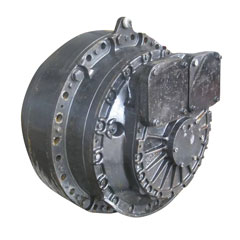
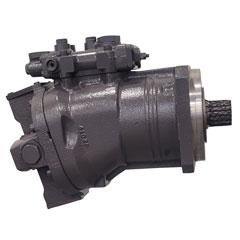
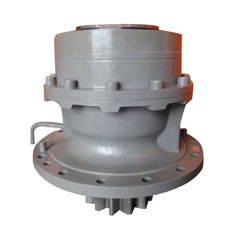
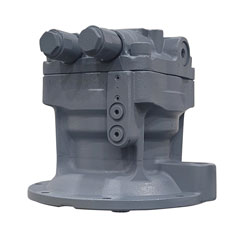
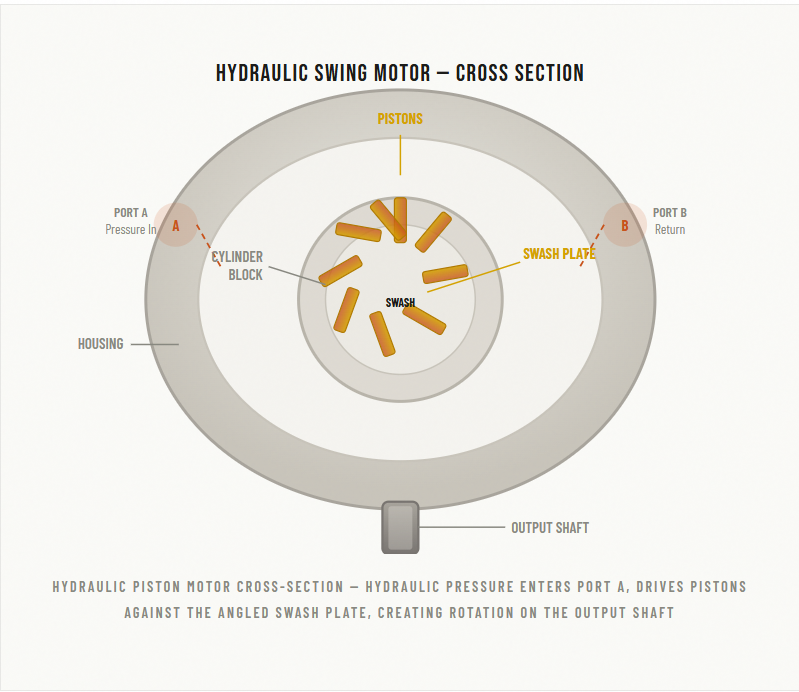
Before you can diagnose a problem, you need to understand what you’re dealing with. An excavator swing motor is a hydraulic piston motor working in concert with a planetary gear reduction unit. Together, they convert hydraulic pressure into the controlled rotational force that swings your machine.
-
Swash PlateThe angled plate that pistons push against. Its angle determines the stroke length of each piston and therefore the torque output. Wear here is often catastrophic and irreparable.
-
Cylinder Block & PistonsThe pistons reciprocate in the cylinder block bores under hydraulic pressure. Wear between pistons and bores causes internal leakage, reducing efficiency before failure.
-
Valve PlateControls the timing of hydraulic flow into and out of each cylinder bore. Scoring on the valve plate face is a key failure indicator during teardown inspection.
-
Shaft Seals & O-RingsThe first line of defence against external leaks. These are the most common repair items — relatively low cost, but critical if ignored.
-
Planetary Gear ReductionBolted directly to the motor, this gearbox reduces output speed and multiplies torque. Damaged planetary gears typically require full assembly replacement.
How the Swing Circuit Works
Knowing how hydraulic pressure flows through the swing circuit is essential for distinguishing whether a problem originates in the motor itself, the control valve, the hydraulic pump, or the lines. A misdiagnosis leads to an expensive wrong part and your machine still won’t work.
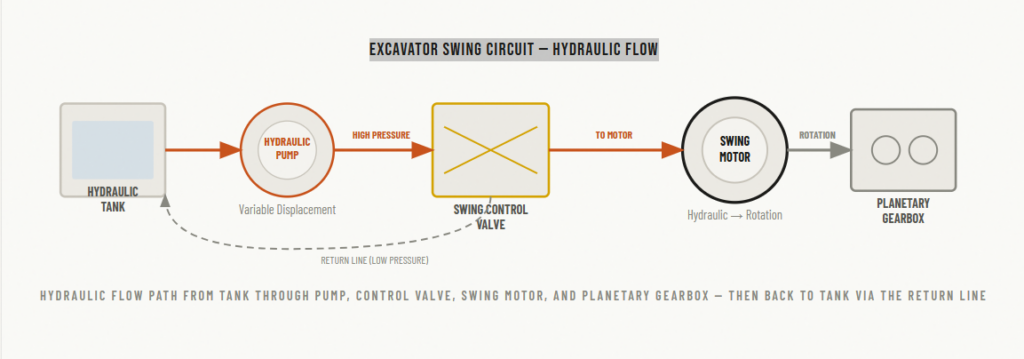
The variable displacement hydraulic pump draws fluid from the tank and delivers it at high pressure, often 3,000–5,000 PSI, to the swing control valve.
Moving the swing joystick shifts a spool inside the control valve, directing high-pressure fluid to either Port A or Port B on the swing motor, determining direction and speed.
Pressurized fluid pushes against pistons in the cylinder block. The angled swash plate converts this reciprocating force into rotation on the output shaft.
The motor spins fast but with moderate torque. The planetary gearbox reduces speed and multiplies torque dramatically, delivering the force needed to rotate a fully loaded upper house.
When Your Motor Starts Talking
Your excavator often provides audible and physical warnings long before a complete breakdown. The key is knowing what each symptom actually means and which ones demand immediate shutdown versus monitoring.

Swing motor symptom severity — from “monitor and book a service” to “shut down immediately”
A healthy swing motor operates quietly. Unusual knocking or banging often indicates cavitation, the rapid formation and collapse of air bubbles under pressure, or air entrained in the hydraulic fluid. This creates micro-impacts that destroy precision surfaces.
What to check: Low fluid level, clogged case drain line, blocked suction filter, or air leak on the pump suction side. Cavitation damage is cumulative and accelerates rapidly.
If the swing motor is struggling due to worn internal components, it generates excessive heat. This damages seals, gaskets, and tarnishes precision machined surfaces, including the swash plate and valve plate face. Fluid above 82°C breaks down rapidly.
What to check: Hydraulic cooler condition and airflow, fluid level and condition, internal motor efficiency (flow meter test), and relief valve settings.
External fluid around the motor housing or case drain line is visible and easy to catch early; it’s typically a shaft seal or o-ring repair. Internal leakage is harder to detect, manifesting as reduced swing speed, power loss, and a hot motor case rather than visible fluid.
Internal leakage test: measure case drain flow with the motor running at full swing. Excessive case drain flow (consult OEM spec) indicates worn pistons or cylinder bores.
If rotation feels jerky, hesitant, or lacks its usual power, especially on an incline where gravity loads the swing, the motor may have uneven piston wear, sticking valve spools, or severely deteriorated internal sealing.
Do not continue operating with erratic swing movement. Uncontrolled rotation with a loaded bucket is a serious safety hazard to ground workers and nearby equipment.
A gradual reduction in swing speed, especially if other hydraulic functions remain normal, is an early indicator of internal motor wear. As piston-to-bore clearances increase, fluid bypasses internally rather than driving the pistons, reducing efficiency.
This is the best time to act. A motor caught at this stage may be a candidate for a professional rebuild rather than full replacement, saving significant cost.
Hydraulic fluid should be amber and translucent. Dark brown or black fluid means it’s thermally degraded. Milky fluid means water contamination. Metallic sheen or particles indicate metal-to-metal wear inside the motor is a red alert requiring immediate teardown.
Sample your fluid from the return line or tank. Particle counts from a lab test provide early warning weeks before physical symptoms develop.
How to Diagnose the Problem
Before calling for a part, you need to confirm the swing motor is actually the failed component, not the pump, control valve, or lines. Follow this sequence to narrow the fault location accurately.
Before anything else, check level, colour, and smell. Dark fluid, metal particles, or water contamination changes your diagnosis entirely. A low level means you likely have a leak elsewhere in the system feeding the problem.
Operate the boom, arm, and bucket functions. If they are all slow or weak, the problem is likely upstream: a failing hydraulic pump, clogged filter, or system relief valve set too low. If only swing is affected, the motor or swing circuit valve is suspect.
Disconnect the case drain line from the motor and direct it into a container. Run the machine at idle and measure flow for 1 minute. High case drain flow, beyond OEM spec, confirms internal wear. This test definitively confirms motor failure without disassembly.
Using a calibrated pressure gauge at the motor ports, check swing circuit pressure with the machine stalled against a fixed stop. Low pressure points to a faulty swing relief valve is a simple, inexpensive repair often confused for motor failure.
Look for fluid at fittings, weeping around the shaft seal, or wetness on the motor housing. Check the case drain line for restriction. A blocked drain creates excessive back-pressure inside the motor, destroying shaft seals rapidly.
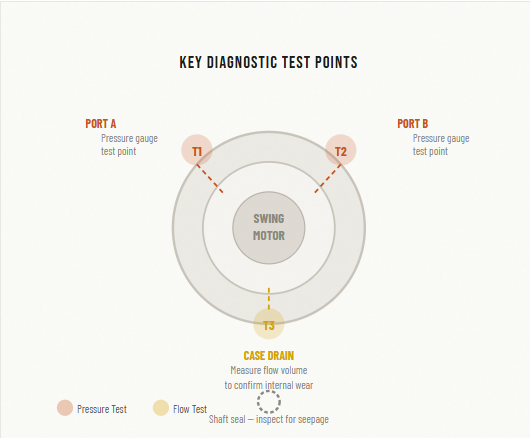 Three diagnostic test points: pressure at Ports A and B, and volumetric flow at the case drain line
Repair vs. Replace
Not every swing motor issue requires a total replacement. Equally, not every problem is worth patching. Here’s how to read the situation correctly and the financial logic behind each decision.
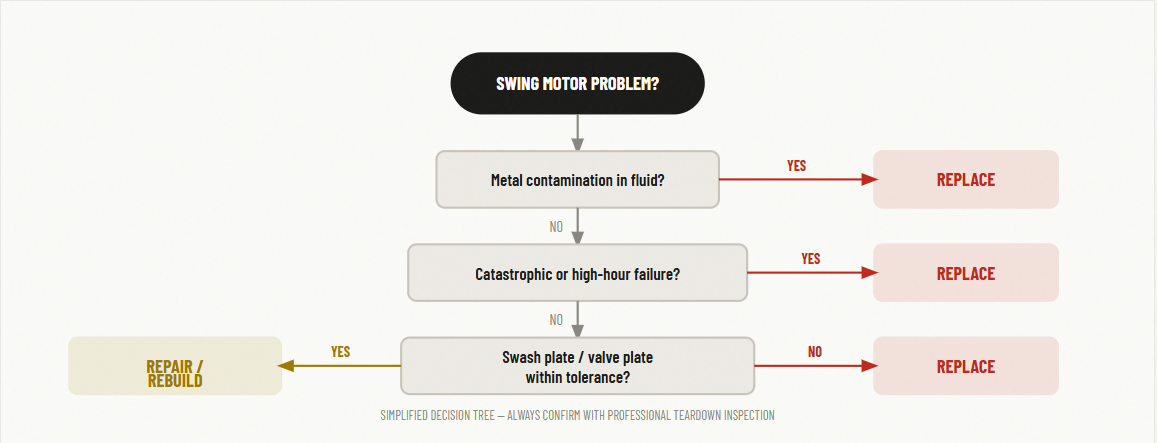 Decision tree for repair vs. replace: the key issue is whether core components are within factory tolerance, which requires disassembly to confirm
- The issue is localized to external components — shaft seals, o-rings, or fittings. These repairs are straightforward and inexpensive.
- A small external leak was caught early. You may only need to tighten or replace a valve or seal before internal damage occurs.
- The machine is relatively new and the failure was thermally induced by a temporary factor (extreme heat, blocked cooler) rather than a fundamental mechanical failure.
- Core components — the swash plate and cylinder block bores — measure within factory tolerances on teardown. A professional rebuild with new pistons, valve plate, seals, and o-rings can restore near-new performance.
- The swing motor shows reduced efficiency (slow swing), but case drain flow is only moderately elevated, indicating early-stage wear that responds well to a rebuild.
- Metal contamination: Hydraulic fluid with metallic particles acts like grinding compound, destroying precision bores, valve plate faces, and swash plate surfaces simultaneously. No rebuild can fully address this.
- Catastrophic failure: A sudden, warning-less breakdown caused by hydraulic system overload, typically leaves behind cracked housings or bent shafts that cannot be economically repaired.
- High operational hours: On machines with significant hours, clearances between pistons and cylinder bores increase naturally. A worn-out block and swash plate means the core assembly must be replaced since there’s nothing left to rebuild around.
- Damaged planetary gears: Pitted or cracked planetary gears in the gearbox section. The cost of individual gear sets often exceeds the price of a complete rebuilt assembly.
- In all replacement scenarios, only OEM-grade parts or factory-tested assemblies guarantee correct fit, rated torque output, and rotational speed specification.
Hydraulic Fluid & Maintenance
The single most cost-effective thing you can do for your swing motor is maintain clean, correctly specified hydraulic fluid at the right temperature. The majority of premature swing motor failures trace back to fluid condition not mechanical defect.
Hydraulic fluid that is too thin (low viscosity) at operating temperature fails to maintain the hydrodynamic film that separates moving metal surfaces. Too thick, and it starves pistons of adequate flow on cold starts. Always use the viscosity grade specified in your OEM service manual, typically ISO VG 46 or 68 depending on climate.
As little as 0.1% water in hydraulic fluid causes cavitation, reduces lubrication, promotes microbial growth in the tank, and causes rust on precision steel surfaces. Water enters through condensation, a failed cooler, or contaminated fluid drums. Milky-coloured fluid is the tell-tale sign.
A bypassing return filter is the highway that particle contamination uses to reach your swing motor. Follow OEM change intervals and change earlier if your machine is working in dusty, high-temperature, or demanding environments. Never let a clogged filter bypass for the sake of time.
Recommended Maintenance Schedule
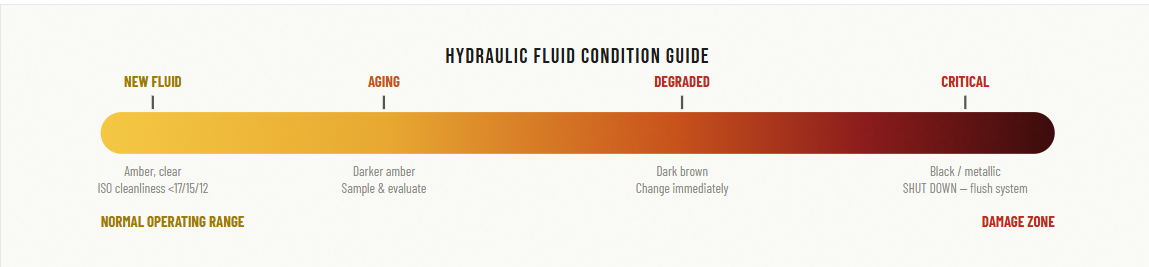 Hydraulic fluid condition guide: fluid colour is a quick field indicator, but ISO particle count analysis is the only reliable early-warning method
Quality Parts = Safety
Whether you choose to repair or replace, the quality of components used is paramount. For owners of Hitachi, John Deere, Caterpillar, Volvo, and Link-Belt excavators, using genuine or OEM-grade parts is not just about performance—it’s a critical safety requirement.
A sudden swing motor failure during rotation can cause the upper house to swing uncontrollably. With a loaded bucket, this creates a lethal hazard for ground personnel and nearby equipment. There is no such thing as an “acceptable” inferior part on a component this critical.
Inferior parts may lack the metallurgical additives to withstand high-duty cycles, failing prematurely and contaminating your entire hydraulic system with debris. Saving money on the part often costs ten times as much in system damage.
Every component undergoes a thorough inspection before it ships, verifying it meets factory specifications and is ready to install and perform from day one. No shortcuts, no guesswork.
All rebuilt units are restored with brand-new o-rings, shaft seals, and gaskets every time, without exception. Reusing original seals is a false economy that guarantees early failure.
Parts are sourced and validated against original factory specifications for fit, clearance, and rotational speed. Mismatched tolerances cause uneven wear and accelerated failure from the first hour of operation.
Quality parts contain the metallurgical additives and heat treatments required to survive the punishing demands of forestry, mining, and construction environments where duty cycles far exceed anything a light industrial part can handle.
The True Cost of Downtime
The real cost of a failing swing motor isn’t just the price of the part, it’s the cascading financial impact of lost productivity, idle labour, delayed project milestones, and potential contract penalties. For many contractors, a single week of excavator downtime costs more than the most expensive replacement motor available.
By maintaining a proactive maintenance program and identifying issues at the earliest warning signs, you gain the ability to schedule repairs at the most convenient time for your project timeline. A planned repair, ordered and executed during non-critical downtime, costs a fraction of an emergency breakdown mid-project.
Consider also the domino effect: a failed swing motor often contaminates the entire hydraulic system with metal debris. A $3,000 motor replacement can become a $15,000+ system flush and multi-component replacement if contamination is ignored or catches you by surprise.
Langley Excavator Parts
Since 1977, the team at Langley Excavator Parts has been an industry leader built on the principles of honesty, integrity, and quality. Since 1995, we have specialized exclusively in sourcing, rebuilding, and shipping reliable hydraulic components for the most trusted excavator brands in the world.
Unlike generalist parts suppliers, we live and breathe excavator hydraulics. When you call us, you’re speaking to a technician who has torn down the exact model of motor you’re asking about, not a parts counter clerk reading from a catalogue.
One of the largest and most diverse inventories of excavator hydraulic components in North America, giving you access to the part you need, when you need it, without waiting weeks for a factory order.
Dave Morrison and Mike Van Boeyen bring decades of hands-on mechanical experience to every customer interaction, ensuring you get accurate technical guidance before you order, not a return label after.
New factory replacement, professional rebuilt unit, or budget-conscious refurbished option — we match the right tier to your machine’s age, hours, and project requirements. No upselling, no guesswork.
Contact us before you make a decision. We’ll walk through the symptoms with you, confirm the diagnosis, and help you decide whether repair or replacement is the right economic choice for your specific situation.
Expert Answers
The questions our technical team hears most often from excavator owners and operators dealing with swing motor issues.
How can I tell if the swing problem is the motor or the hydraulic pump?
The fastest test: operate other hydraulic functions (boom, arm, bucket). If they’re all weak or slow, the problem is likely the pump or main relief valve, not the swing motor. If only swing is affected, suspect the motor or swing circuit specifically.
Confirm by measuring case drain flow on the motor with a flow meter. High case drain volume confirms internal motor wear. Also check swing circuit relief valve pressure with a calibrated gauge — a faulty, low-pressure relief valve is a common and inexpensive fix that mimics motor failure symptoms.
What’s the difference between a rebuilt, refurbished, and new swing motor?
A new factory motor is manufactured to full OEM specification — the highest performance and longest expected lifespan. Best for newer machines or demanding operations.
A rebuilt motor is completely disassembled, inspected, and reassembled with new pistons, seals, valve plate, and any worn components — providing near-new performance at 40–60% of new cost. The quality depends entirely on who does the rebuild and what parts they use.
A refurbished motor receives targeted repairs to address the specific failure without full disassembly. Budget-friendly, but only appropriate when the scope of failure is clearly limited.
Can the wrong hydraulic fluid really destroy my swing motor?
Yes, and it can do so surprisingly quickly. Hydraulic fluid that is too thin at operating temperature fails to maintain the hydrodynamic film between pistons and cylinder bores, causing metal-to-metal contact. Too thick, and it cavitates at start-up, causing the same damage through air bubble collapse.
Lower-quality fluids may also lack the anti-wear additives and oxidation inhibitors required for high-duty hydraulic systems. These fluids degrade faster, produce varnish deposits that stick valves, and fail to protect precision surfaces in high-load conditions.
My swing is slow but there are no leaks and no strange noises. What’s happening?
Slow swing without obvious external symptoms typically indicates one of three things: (1) internal motor wear increasing bypass flow, (2) a faulty or improperly set swing circuit relief valve reducing system pressure, or (3) a partially failing hydraulic pump.
Perform the case drain flow test and check swing circuit pressure before ordering any parts. This symptom pattern is also one of the best opportunities to act — motors caught at this stage are often good rebuild candidates, avoiding the cost of full replacement.
Is it safe to keep working if I notice a small external leak?
Not recommended, even for a minor external leak. A seeping shaft seal or weeping fitting can worsen rapidly under operating pressure and heat, becoming a sudden, large pressure loss that compromises your control of the machine mid-swing.
More critically, the fluid lost to the leak will be replaced by air or contaminated return fluid entering through a compromised seal, accelerating internal damage dramatically. A seal repair caught early is a $200–500 job. The same seal left to fail can result in full motor replacement.
How long should a quality rebuilt swing motor last?
A quality rebuild using OEM-specification components with all new seals, a fresh valve plate, and pistons within tolerance typically provides 80–90% of the service life of a new motor when properly installed and maintained. On well-maintained machines with clean hydraulic fluid, this can mean several thousand hours of reliable service.
The key variables are fluid cleanliness, operating temperatures, and whether the root cause of the original failure was corrected before installation. Putting a rebuilt motor into a contaminated system that hasn’t been flushed will dramatically shorten its life.
How often should I inspect the swing motor area?
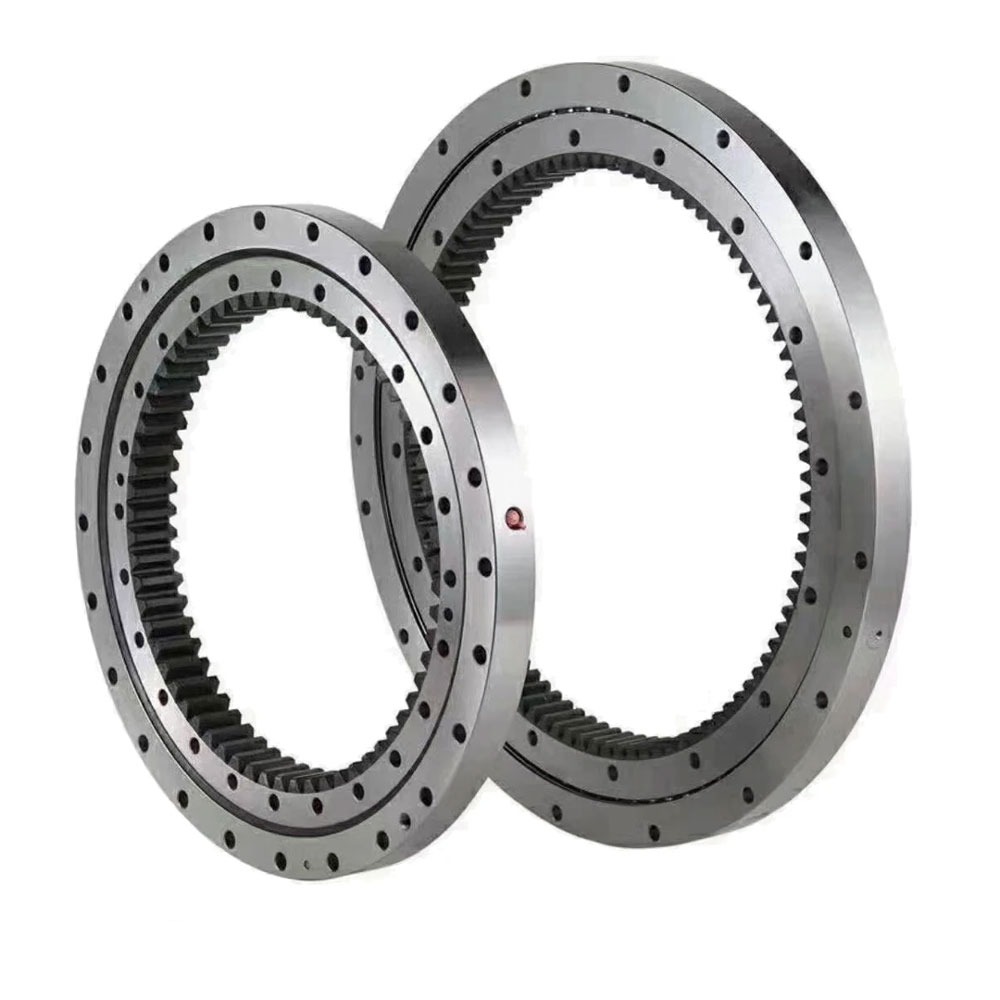
Daily visual checks of the swing area and slew ring are best practice for any machine in regular operation. This takes less than two minutes: look for fresh fluid spots under the machine, weeping around fittings, and any change in the appearance of the motor housing or case drain line.
Listen for new sounds during the first full swing rotation each morning since changes in sound often precede visible symptoms by days or weeks. Early detection consistently saves owners the most money.
Keep Your Machine Moving
Don’t let a failing swing motor halt your project. Contact the technical team at Langley Excavator Parts in British Columbia today to confirm your diagnosis and find the right solution fast.
1-888-530-5444 Toll-Free · Langley Excavator Parts · British Columbia, Canada